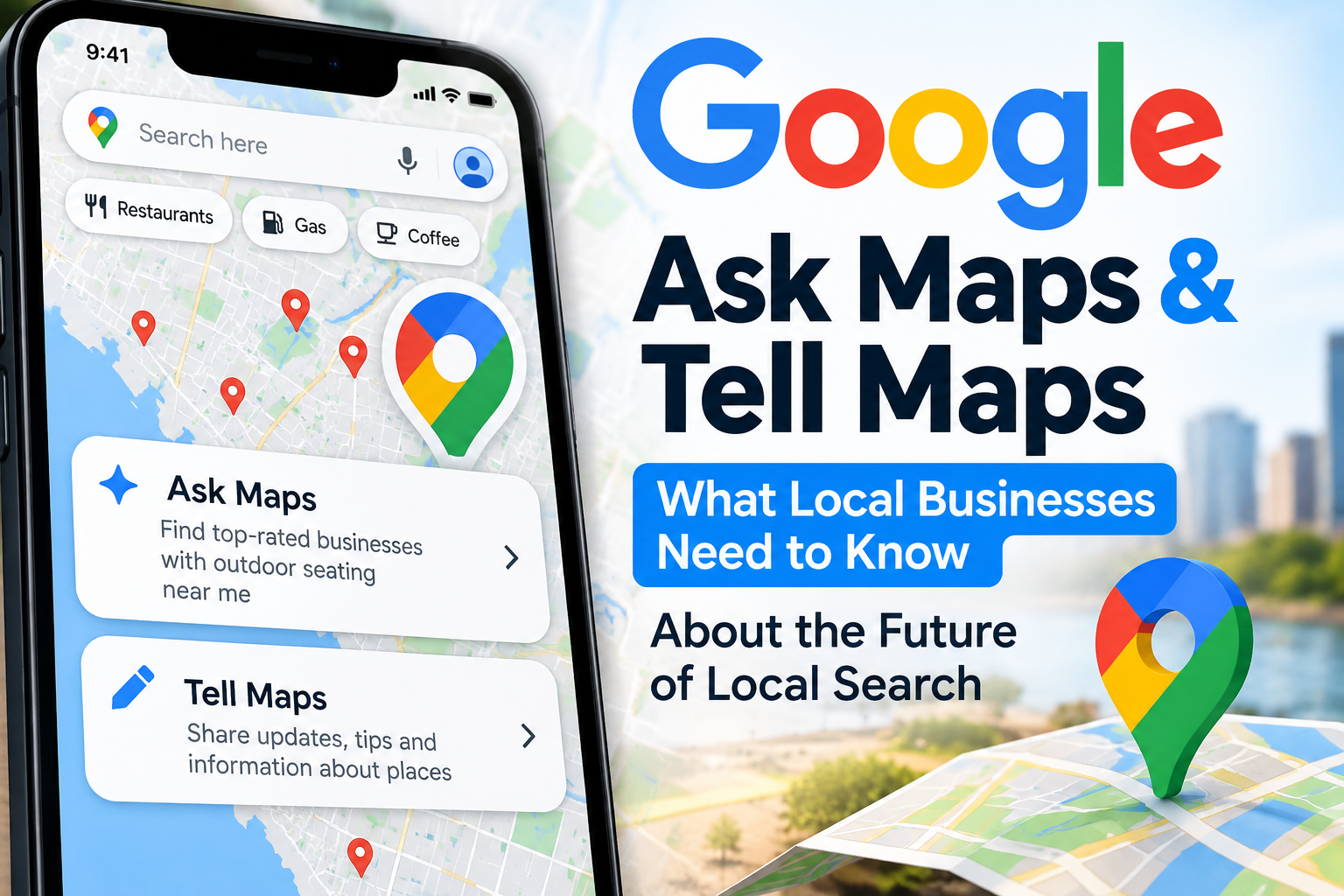
Google Ask Maps & Tell Maps: What Local Businesses Need to Know About the Future of Local Search
Google Maps is becoming much more than a place to search for a business or get directions. With AI-powered features like Ask Maps and Tell Maps, Google is changing the way customers discover local businesses — and that could have important implications for your local visibility.
For years, local businesses have worked to appear when someone searches phrases like:
“plumber near me”
“personal trainer Cape Coral”
“best Italian restaurant nearby”
“roofing company Fort Myers”
Those searches aren't going away.
But Google is increasingly allowing customers to search in an entirely different way.
Instead of typing a traditional keyword, someone can now ask Google Maps a detailed question such as:
“Where can I find a restaurant nearby with outdoor seating that's quiet enough for a business meeting?”
Or:
“Find me a personal trainer who works with adults over 50 and offers joint-friendly strength training.”
Or:
“Who is a roofer near me that offers free estimates and can inspect difficult-to-reach areas?”
That is a significant change.
Welcome to Conversational Local Search
Google introduced Ask Maps, an AI-powered experience using Gemini that lets people have a conversation with Google Maps about places, businesses and things to do.
Rather than simply returning businesses that match a short keyword phrase, Ask Maps can interpret much more detailed requests and recommend places that appear to satisfy those requirements.
Google says Ask Maps draws from information about more than 300 million places, including information from Maps and contributions from its community.
That means the question for local businesses is increasingly becoming:
Does Google understand enough about your business to know when you are a good answer?
Watch: How Ask Maps and Tell Maps Work
The video above demonstrates these newer Google Maps features. Google continues to update their availability and functionality, so some screens or menu locations may differ depending on your device, account and location.
What Is Ask Maps?
Ask Maps allows users to ask natural-language questions about local places.
Instead of:
“restaurants near me”
a customer might ask:
“What restaurants near me have a waterfront view, outdoor seating and are good for watching a football game?”
Instead of:
“landscaper Cape Coral”
someone could ask:
“Find a landscaper nearby that offers eco-friendly options that would be appropriate around pets.”
Ask Maps can then use the information Google has available to identify businesses that may fit that request.
Google's current Help documentation shows Ask Maps available through Google Maps on supported mobile experiences and on the desktop Maps experience as well.
This creates an important new layer of local search optimization.
It isn't only about matching a keyword anymore.
It's about business understanding.
What Is Tell Maps?
Google has also introduced Tell Maps, an AI-powered contribution experience.
Tell Maps allows people to conversationally contribute information about places, including things such as:
updating business information
reporting hours
updating place attributes
sharing local tips
uploading photos
indicating that a location has closed
Google currently documents Tell Maps as a U.S. feature through its Android Maps experience. Availability can continue to change as Google expands its AI products.
Tips submitted through Tell Maps may potentially appear elsewhere across Google, including areas such as Google's “Know before you go” information.
That makes Tell Maps interesting.
But there is also an important distinction every business owner should understand.
Tell Maps Is Not a Keyword-Stuffing Tool
You may see marketing advice suggesting that businesses can simply “tell Google” every keyword they want to rank for.
We would be careful with that interpretation.
Google does not currently document Tell Maps as a direct local ranking factor or as a way to guarantee rankings.
Google's official guidance continues to say that local search results are primarily determined by:
Relevance — how well the business matches what someone is looking for.
Distance — how far the business is from the searcher or location being searched.
Prominence — how established or well-known the business appears to be, including signals such as reviews, links and information available across the web.
Tell Maps should therefore be viewed as another way Google's ecosystem can collect accurate information about the real world, not as permission to artificially insert search terms.
Google's Maps policies also require contributions to be genuine, useful and accurate and prohibit misleading, repetitive or purely promotional contributions.
So Why Should Local Businesses Care?
Because Ask Maps demonstrates where local discovery is heading.
Consider a restaurant that has:
a giant television for sporting events
pet-friendly outdoor seating
waterfront dining
gluten-free options
live music on weekends
If Google clearly understands all five of those things, that restaurant potentially has more opportunities to be relevant to very specific customer searches.
The same principle applies to nearly every industry.
HVAC Company
Customers might search:
“HVAC company offering same-day service.”
“Air-conditioning company with maintenance plans.”
“HVAC contractor that offers free estimates.”
Personal Trainer
Customers might ask:
“Personal trainer experienced with adults over 50.”
“Trainer offering semi-private personal training.”
“Strength training for beginners with physical limitations.”
Roofing Company
A customer might search:
“Roofer offering free inspections.”
“Roofing company that uses drone inspections.”
“Contractor experienced with metal roofs.”
Dentist
Customers could ask:
“Dentist nearby offering Invisalign.”
“Dentist with evening appointments.”
“Family dentist that accepts new patients.”
Landscaper
Someone could ask:
“Landscaper offering organic or pet-friendly lawn options.”
“Company that installs Florida-friendly landscaping.”
“Landscaper experienced with low-maintenance yards.”
These aren't simply keywords.
They're customer questions.
And that's the real opportunity.
Your Business Needs a Clear Digital Identity
If Google is going to answer increasingly sophisticated questions about your company, the information surrounding your business needs to be consistent, detailed and understandable.
That includes much more than putting a few keywords into a Google Business Profile.
A strong local visibility ecosystem can include:
Your Google Business Profile
Your categories, services, description, hours, photos, products and other profile information should accurately explain what your business does.
Your Website
Your website should clearly describe individual services, specialties, service areas, differentiators and the questions customers are actually asking.
Customer Reviews
Authentic reviews can give Google additional context about customers' real experiences with a business.
Don't script or manipulate reviews. Instead, make it easy for legitimate customers to describe what they genuinely valued about their experience.
Local Business Citations
Consistent information across relevant directories and business databases helps reinforce the identity of your company across the web.
Photos and Videos
Visual information can help both customers and search platforms better understand a business, its products, services and location.
Relevant Content
Articles, service pages, FAQs and videos can answer the questions prospective customers are asking before they ever contact you.
From “Keywords” to “Entities, Context and Answers”
Traditional SEO isn't disappearing.
Keywords still matter because language tells search engines what something is about.
But AI-powered search increasingly adds another question:
What does Google understand about this business?
For example, two businesses may both be categorized as personal trainers.
But Google could potentially understand one as:
Personal trainer → adults 50+ → strength training → semi-private training → beginner friendly → Cape Coral
while another might be understood as:
Personal trainer → competitive athletes → sports conditioning → performance training → Fort Myers
Those businesses might serve very different searches even though they share the same primary business category.
This is why simply “having a Google Business Profile” is no longer enough.
The goal is to build a strong, consistent picture of:
Who you are.
What you do.
Where you do it.
Who you serve.
What makes you different.
And why you may be relevant to a particular customer's search.
A Simple Test You Can Try
Open Ask Maps, if it's available in your Google account, and search the way a real customer might.
Don't search your company name.
Instead, ask detailed questions that describe your ideal customer and the service they need.
For example:
“Who offers [specific service] near me?”
Then make the question more detailed:
“Who offers [specific service] for [type of customer] in [location] with [important differentiator]?”
See which businesses Google recommends.
Then ask yourself:
Would Google have enough information to know that my business belongs in this conversation?
That can be an extremely revealing exercise.
The Bigger Picture: Google Is Moving Toward Answers, Not Just Listings
Google Maps is no longer simply showing pins on a map.
Google is building an AI-powered system that can understand a customer's situation, interpret what they're looking for and help them decide where to go.
Ask Maps can already handle complex conversational searches and, in some situations, help users take actions such as making reservations or starting food orders directly from the conversation.
For local businesses, that makes one thing increasingly important:
Make your business easy for Google — and your customers — to understand.
The businesses that build accurate, complete and consistent information across their Google Business Profile, website, reviews, directories, content and other online signals may give search platforms a much clearer picture of when that business is relevant.
And relevance remains one of Google's three primary local ranking factors.
Is Google Really Understanding Your Business?
That's one of the things we look for with the Local Conversion System by Conversion Is Key.
We take a holistic look at the signals surrounding your local business — including Google visibility, Google Maps, your Business Profile, website, local citations, reviews, content, AI search visibility and other factors that can affect whether customers can find you, trust you and ultimately choose you.
Get Your FREE Local Conversion Audit
See how local customers may be finding your business — and where you may be losing them.
Visit LocalConversionSystem.com
Get Found. Get Trusted. Get Chosen.™